
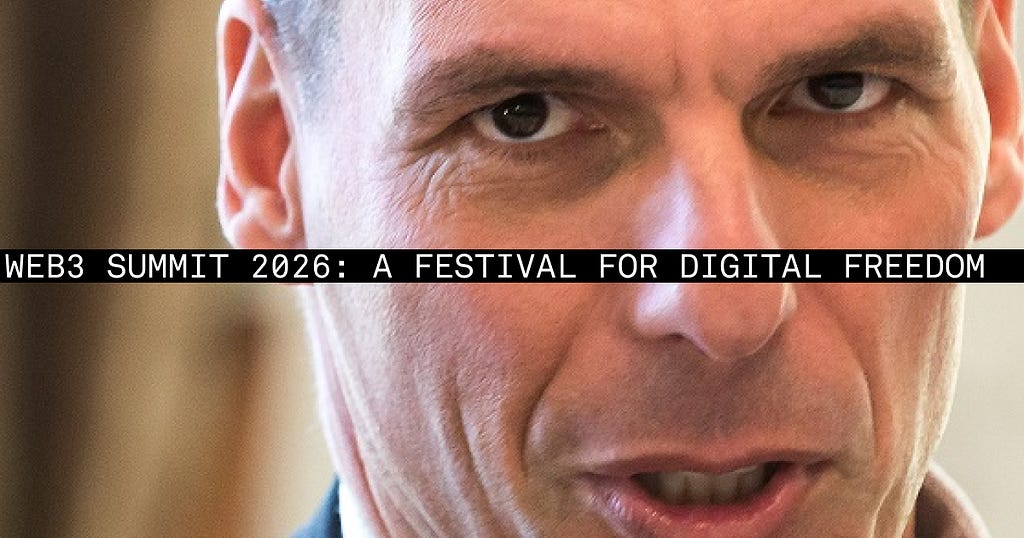
As Europe’s debate over privacy, surveillance, and digital sovereignty intensifies, Web3 Summit 2026 brings Yanis Varoufakis, Amir Taaki, Gavin Wood, and other rebel voices to Berlin to confront one urgent question: who should control our digital future?
Web3 has never been only about code, blockchain infrastructure, or tokens. Its essence has always been about power: who holds it, who profits from it, and whether the people can reclaim any meaningful control over their digital lives. That’s why today’s announcement that Yanis Varoufakis will headline Web3 Summit 2026 in Berlin feels so significant.
The economist, controversial political thinker, and former Greek Finance Minister has built a global reputation as one of the most uncompromising critics of concentrated economic and technological power. His presence at the Summit, taking place at the historic Funkhaus Berlin on 18 and 19 June 2026, is sure to give the event a sharper political charge.
This is by no means another industry gathering. Rather, it’s a public confrontation with the most crucial question of the digital age: who controls the systems we now live inside?
Yanis Varoufakis: The Wake-Up Call Web3 Needs
Varoufakis joins the Web3 Summit at a time when his outspoken ideas feel unusually urgent. His critique of platform capitalism, rent extraction, and what he has described as a new form of techno-feudal power speaks directly to the reality of today’s internet.
Users create the content. Users generate the data. Users train the algorithms through every click, search, message, and transaction. Yet the ownership, governance, and economic upside remain centralized in the hands of a few dominant platforms. Varoufakis has warned that today’s platform giants do not merely host public debate; they increasingly own the conditions under which it happens. As he put it to
The Guardian, “They own the agora itself — the servers, the feeds, the algorithmic means of communication.” That imbalance is no longer a niche concern. Across Europe, debates over privacy, encrypted communications, and digital sovereignty have moved into mainstream politics. The EU’s controversial “chat control” proposals, aimed at scanning private messages to detect child abuse material, have triggered fierce opposition from privacy advocates and German data protection authorities, who warn of mass-surveillance risks. Against this backdrop, Varoufakis is the right provocation at the right time.
https://medium.com/media/9b467c3e1ca8fd6197240437dd232d8b/href
From Platform Dependency to User Sovereignty
The Summit is being framed as a festival for digital freedom, and the phrase lands differently now than it would have a few years ago. It speaks to a growing reality in which people are tired of being treated as products, data sources, and passive users within systems they cannot meaningfully influence.
Beyond chat control proposals, the EU’s Digital Markets Act is forcing a broader reckoning with platform gatekeepers, interoperability, and user choice, while the rise of AI has increased concerns about how personal data is collected, reused, and monetised. People are no longer simply asking whether digital platforms are convenient. They are asking whether these platforms are becoming too powerful, too extractive, and too deeply embedded in public life to remain unaccountable.
This is where the Summit’s core themes — privacy, self-sovereignty, and decentralised usability — become more than Web3 buzzwords. They point to a practical challenge in building digital systems in which users are not subjects of platforms or algorithmic control but active participants with ownership, agency, and exit rights.
The Voices Reclaiming the Internet
While Varoufakis brings political force, challenging the concentration of economic and technological power, Gavin Wood offers a complementary view from the infrastructure side.
As co-founder of Ethereum and creator of the Polkadot network, Wood represents the original Web3 argument: that the internet can be rebuilt around user control, open protocols, decentralised governance, and systems that do not require blind trust in centralised intermediaries.
The evolving line-up extends the debate across culture, usability, and Web3’s radical roots. Joan Westenberg examines platform dependency and its social impact on identity and attention. Friederike Ernst, co-founder of Gnosis, focuses on making self-sovereignty usable through self-custody and real-world tools. Amir Taaki, cypherpunk and early Bitcoin developer, brings the movement back to cryptography, free software, privacy, and resistance to centralised control. Joshua Dávila and Rachel-Rose O’Leary add further depth to the programme, with more speakers still to be announced.
Together, they ask whether decentralised technology can offer a serious alternative to surveillance, dependency, and digital enclosure.
Playground.dot: Build the Alternative.
The Summit will also turn that argument into something tangible through Playground.dot. Talking about alternatives for two days is one thing; experiencing them is another.
Playground.dot will give developers, vibe coders, and curious participants the chance to take a working application, modify it and deploy their own version of it on a fully decentralised stack in as little as 30 minutes. Hosting, storage, domains, and user accounts are decentralised by design, with privacy built in from the start.
Web3 Summit is not just asking if technology can work differently. It is showing that mature alternatives already exist, and that people can start using them now.
Your Voice Matters
Held during Berlin Blockchain Week, Web3 Summit 2026 will bring together artists, founders, technologists, and cultural thinkers through talks, workshops, activations, and open collaboration, with crypto ticketing and a decentralised conference app powered by the Polkadot stack putting its values into practice.
Digital freedom will not be built by spectators. It needs people willing to speak up, build, question, experiment, and demand better systems.
Check out the lineup and get tickets at: https://web3summit.com/
About Yanis Varoufakis Yanis Varoufakis leads MeRA25 in Greece and is co-founder of the paneuropean movement DiEM25 as well as the Progressive International. An academic economist who served as Greece’s Finance Minister in 2015, Varoufakis is the author of best-selling books, including RAISE YOUR SOUL (Penguin, 2025), TECHNOFEUDALISM: What killed capitalism (Penguin 2023), ANOTHER NOW (Penguin 2020), ADULTS IN THE ROOM (Penguin 2017), TALKING TO MY DAUGHER (Penguin 2017), AND THE WEAK SUFFER WHAT THEY MUST? (Penguin 2016), THE GLOBAL MINOTAUR (Zed Books 2011).

The Voices Fighting for Digital Freedom: Yanis Varoufakis to Headline Web3 Summit 2026 was originally published in Web3 Foundation on Medium, where people are continuing the conversation by highlighting and responding to this story.


